 ZIEN
Security flaws discovered in internationally certified devices highlight growing need for AI-driven vulnerability assessment
During recent hearings at South Korea’s National Assembly, lawmakers called for stronger protection of IoT devices and wireless infrastructure, emphasizing the urgent need for preemptive security testing in consumer electronics such as robot vacuums and home surveillance systems.
In alignment with this concern, the Korea Internet & Security Agency (KISA) and the Korea Consumer Agency (KCA) conducted a nationwide security analysis on commercially distributed robot vacuum cleaners.
The investigation identified vulnerabilities across 40 security evaluation items, including forced camera activation, unauthorized video extraction, malware delivery, and missing firmware protection settings — even in products that were already certified under international standards such as ETSI EN 303 645. This outcome confirms that certification alone does not guarantee real-world product security.
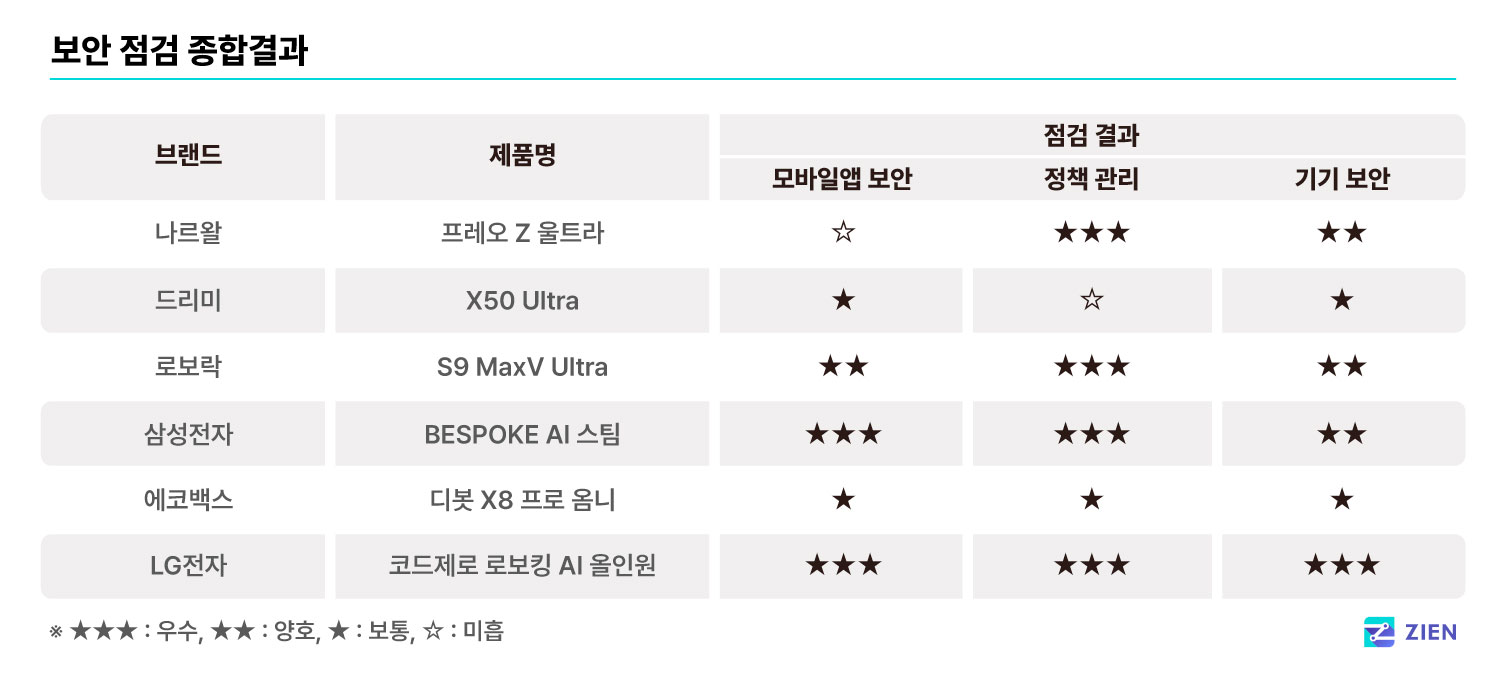
The investigation officially incorporated ZIEN’s Intelligent Firmware Security Platform, “Z-IoT.”
Leveraging automated binary analysis, Z-IoT rapidly identified potential attack vectors — such as forced camera activation — that would be extremely difficult to detect manually. With manufacturers facing staff shortages and increasingly complex IoT firmware, AI-based automated testing is emerging as the most practical approach to securing connected devices.
“This case clearly demonstrates that even globally certified products can be vulnerable in actual use,” said Youngmin Cho, CEO of ZIEN. “To protect consumers and maintain brand trust, automated AI-driven security validation must be performed prior to product release.”
Z-IoT performs web-based, installation-free firmware and application analysis. It supports zero-day vulnerability detection, SBOM generation and risk monitoring, automated mapping against global security standards (EN 18031, EN 303 645, NIST IR, etc.), and AI-driven mitigation guidance. It is currently being adopted by manufacturers in smart appliances, healthcare, industrial automation, and mobility, offering practical compliance support even in environments with limited security expertise.
ZIEN has expanded its research in collaboration with KISA, KEA, and SK Intelix, and holds eight domestic and international patents, along with accolades from several global hacking competitions. The company is also actively partnering with Bureau Veritas, a leading global certification body, to accelerate regulatory compliance for international market expansion.
“Beyond Z-IoT, we are building a holistic device security ecosystem through solutions such as ‘Z-GRC’ (AI-based compliance automation) and ‘Z-BOM’ (software supply chain risk management),” Cho added. “Through our SaaS offerings, we aim to help manufacturers proactively adapt to emerging cybersecurity regulations and contribute to a safer, more connected future.”
Additionally, CEO Cho will present “Robot Vacuum Cleaners: A New Attack Surface in the AIoT Era” at the upcoming AIoT International Conference on the 27th, where he will share details from the investigation and examine how AI-based automated security validation can shape next-generation IoT protection strategies.
Source: Boan News