 ZIEN
The number of Internet of Things (IoT) devices reached 16.7 billion in 2023 and is expected to climb to 40 billion by 2030. From smart homes and cities to autonomous vehicles and factory equipment, the growth of connected devices brings unprecedented convenience—but also increasing vulnerability to cyber threats.
ZIEN, a convergence security company specializing in Extended IoT (XIoT)—which includes all devices combining cyber and physical elements—has introduced AI-powered solutions to address rising security challenges. These include Z-Sentinel, a real-time IoT device identification and threat detection platform, and Z-IoT, a cloud-based automated firmware vulnerability assessment service.
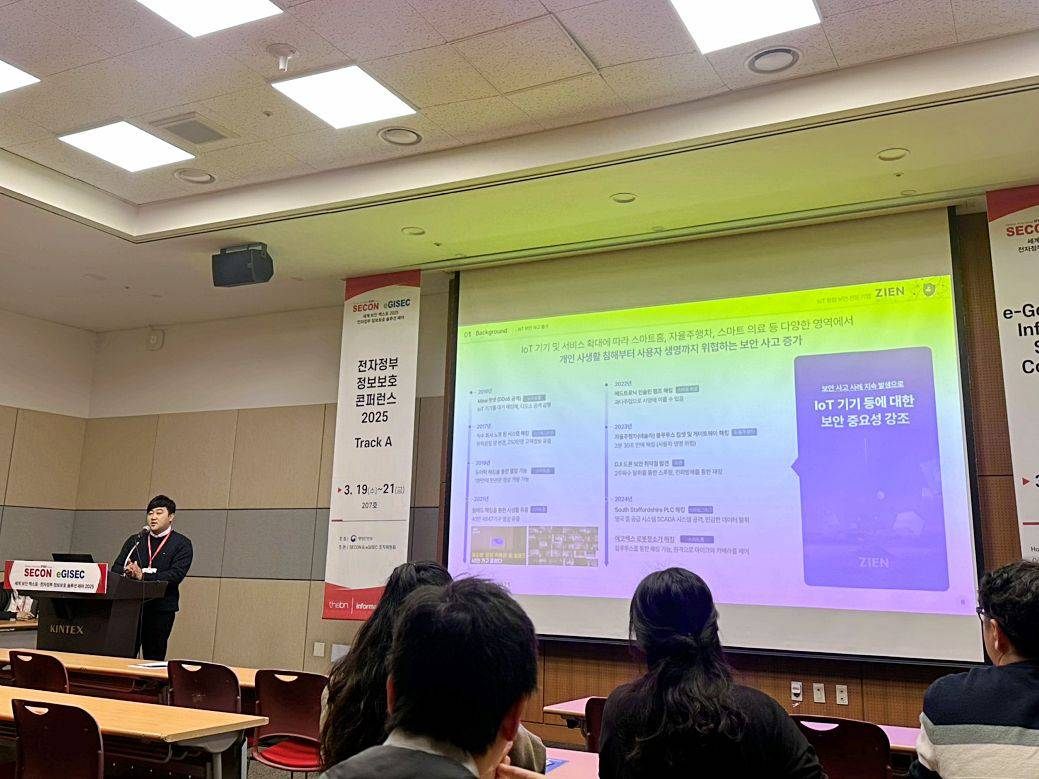
At the conference, held during SECON & eGISEC 2025 last month, ZIEN CEO Young-min Cho presented on “IoT Security Innovation: Device Identification and Anomaly Detection.” In his session, Cho highlighted recent incidents involving hacked IoT devices and called for stronger safeguards against emerging threats.
From Privacy Breaches to Life-Threatening Risks
IoT-targeted attacks have led to serious consequences ranging from privacy violations to public safety threats. Notable cases include the 2016 Mirai botnet DDoS attack and the 2021 wallpad hacking incident in Korea, which compromised the privacy of over 400,000 households. In more recent cases, a Bluetooth vulnerability in a robot vacuum enabled remote control of its microphone and camera, while attacks on Bluetooth gateways in autonomous vehicles, including Tesla, raised alarm over the physical safety risks posed by IoT vulnerabilities.
“Despite tightening regulations, implementation in the field remains lacking,” said Cho. “Many attacks now exploit previously unknown vulnerabilities, making proactive and intelligent defense essential.”
Understanding How IoT Devices Are Compromised
IoT devices consist of hardware, mobile apps, cloud servers, and gateways, operating through authentication and firmware at each stage. Hackers first analyze the hardware to gain root access, then examine firmware and services to exploit vulnerabilities. "Firmware is a critical point where the majority of vulnerabilities are found. To prevent IoT hacking, it's essential to first identify and monitor each device, while continuously discovering and reinforcing firmware security vulnerabilities," Cho asserted.
Specifically, hackers collect data sheet information through IC chips on IoT hardware PCB boards. Data sheets, containing detailed guidelines for development, enhance understanding of the device. Based on this, hackers access debugging interfaces (tools that detect and remove errors in scripts) to take control of the device.
After extracting the firmware that controls all IoT device functions, they analyze the file system to find and exploit vulnerabilities. Cho emphasized the importance of open-source inspection, stating, "With more than 80% of firmware incorporating open-source components, devices are easily exposed to threats due to known vulnerabilities in these components. Therefore, it's crucial to eliminate IoT device vulnerabilities in advance through investigation of known security vulnerability disclosure areas."
ZIEN Presents AI-Based IoT Security Solutions
'Z-Sentinel' is ZIEN's AI-based zero-trust IoT security platform that automatically identifies IoT devices and uses AI to analyze network-based vulnerabilities and anomalous behaviors for real-time security threat detection and response. It also blocks discovered vulnerabilities by integrating with security equipment. This solution is provided in an agentless manner, reducing operational burden by managing systems through an integrated dashboard without installing agents.

'Z-IoT' is an XIoT firmware security automatic inspection solution that prevents incidents by quickly and accurately identifying security vulnerabilities in IoT device firmware. "When firmware is uploaded to the solution, the security analysis server automatically analyzes passwords, encrypted files, executable files, open source, and zero-day vulnerabilities (software vulnerabilities unknown to developers), providing customized security guidelines," Cho explained. "Z-IoT has reduced security management time and costs by approximately 75% and 98% respectively compared to manual inspection. In particular, it has automated the process of reverse engineering (discovering technical principles through structural analysis), which typically requires significant time to identify zero-day vulnerabilities."
ZIEN’s technological leadership has been recognized globally. In January, the company discovered zero-day vulnerabilities in vehicle infotainment systems at Pwn2Own Automotive 2025. At DEF CON 32, ZIEN analyzed eight automotive dashcam models, uncovering 30 critical vulnerabilities. The team also ranked first in the “Hack the TV” CTF competition, outperforming 30 teams worldwide.
It's time for continuous attention from government, businesses, and individuals to build a secure IoT environment. Cho stated, "We will help security personnel, including those in public institutions, efficiently manage security systems. We plan to expand into overseas markets such as North America and Europe, while also developing new solutions including Large Language Models (LLM)."
Source : IT Donga